This webpage presents our short- and medium-term macroeconomic projections and outlooks for Canada and Quebec. Our approach relies on a variety of forecasting exercises that cover a wide range of key economic indicators. La version française de cette page est disponible ici.
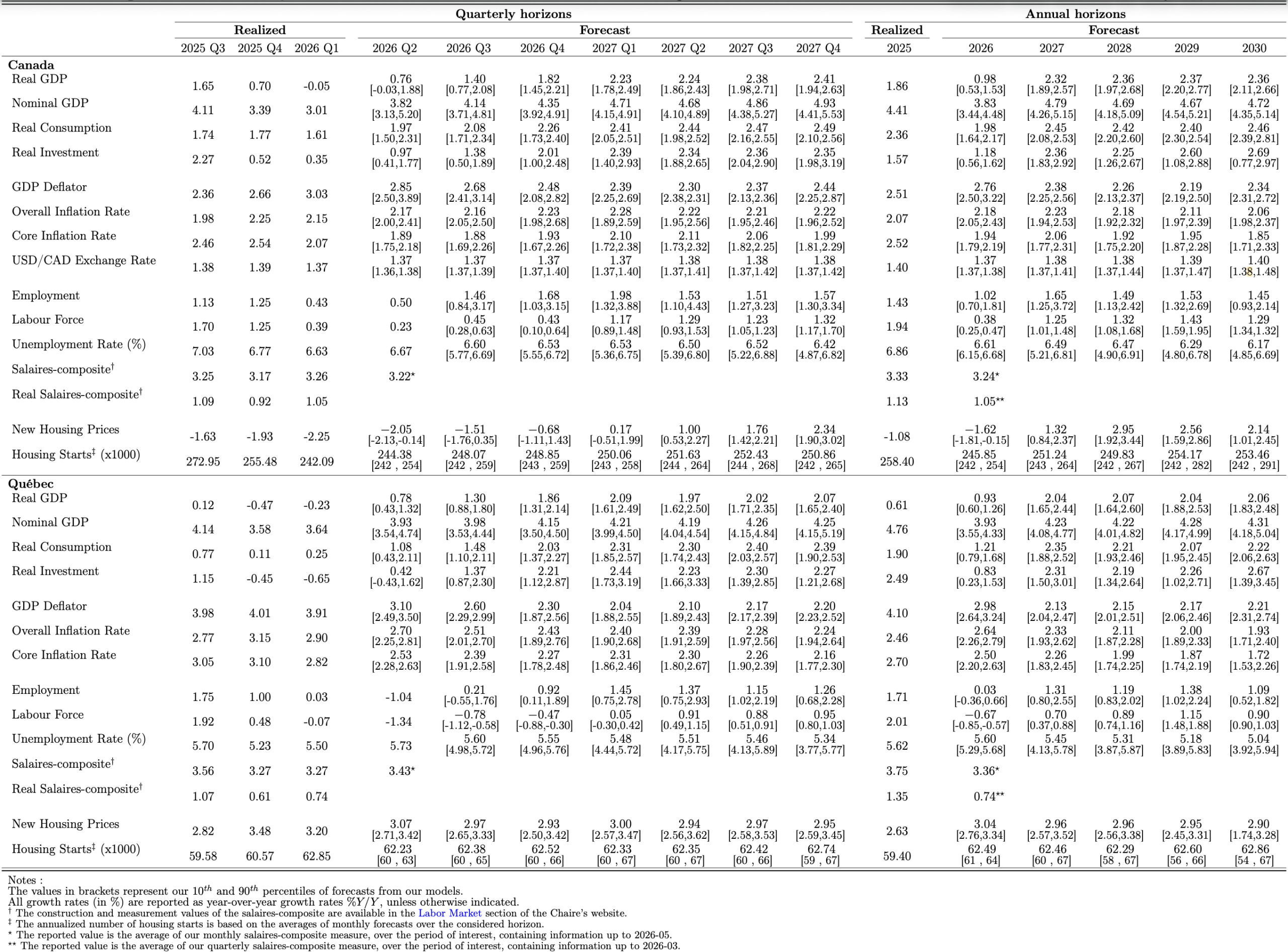
This bulletin updates our short- and medium-term macroeconomic projections for Canada and Quebec. In light of the available data, the forecasting exercises produced from our 37 models describe a revised trajectory for a set of key economic indicators.
Our forecasting approach relies exclusively on extracting statistical regularities from historical data dynamics. It aims to exploit their informational content without imposing any discretionary scenario. This methodology, distinct from conventional approaches used by several organizations, relies on modern econometric techniques to produce our forecasts. The current edition of the Macroscope incorporates 37 predictive models. These include standard regressions, regularization models, and machine-learning techniques applied to a broad set of macroeconomic data. To limit the influence of outliers, we report the median forecast. The uncertainty intervals, defined by the 10th and 90th percentiles, quantify the diversity of scenarios anticipated by our portfolio of models. A wider interval signals greater uncertainty about future developments. The asymmetry of the distribution around the median, that is, the 50th percentile, also allows us to assess the “direction” of this uncertainty. In this edition, quarterly forecasts cover the next seven quarters, while annual forecasts extend from 2026 to 2030. As with any forecasting exercise, unforeseen shocks not incorporated into the models can create gaps between projections and observed outcomes. The geopolitical environment remains volatile and prone to abrupt disruptions. Despite the memorandum of understanding announced in mid-June, the armed conflict between the United States and Iran has resumed and intensified. The closure of the Strait of Hormuz, along with the threat of closing the Bab el-Mandeb Strait, which links the Red Sea to the Gulf of Aden and the Indian Ocean, heightens the risk of disruptions to global energy and commodity markets. Additional pressures stem from the Trump administration’s shifting tariff announcements, the non-renewal of CUSMA on July 1 and the introduction of its annual review mechanism, as well as the recent announcement of plans to impose, within 30 days, a 50% tariff on more than 500 Canadian goods, including products that would otherwise have been exempt under the agreement. Fiscal and monetary policy uncertainties further cloud the outlook and reduce forecast precision.
Nevertheless, the statistical framework underlying the Macroscope remains effective at capturing the current momentum of the Canadian and Québec economies. The forecasts presented here should therefore be viewed as baseline scenarios, assuming no new shocks that could materially alter the economic trajectory.
For more details, the Macroscope report is available: here
(Click on the tables to zoom in)
Forecast table